Turning Labor Market Evidence into a Powerful Decision Making Support Tool for Students
Between 2024 and 2025, Vox Pop Labs partnered with Degreehub and the Canadian Education and Research Institute for Counselling (CERIC) to design Career Myth Buster — a public-facing digital tool created to confront career misinformation directly, using evidence rather than advice or exhortation.
Why career misinformation persists
Young people make some of the most consequential decisions of their lives with remarkably little reliable guidance. Despite unprecedented access to data, students’ perceptions of education and careers are often shaped by persistent myths: that certain degrees guarantee employment, that others are “useless,” or that labor market outcomes are primarily a matter of personal passion rather than structural conditions.
These beliefs are reinforced by social media, anecdotes, and well-meaning but outdated advice. For educators and career practitioners, the challenge is not a lack of data — many countries have extensive labour market information — but a failure of translating that data into actionable insights. Evidence exists, but it rarely reaches students in forms that are accessible, engaging, or capable of providing real and unbiased decision support.
From information gaps to decision traps
Career Myth Buster was grounded in a behavioural insight: misconceptions persist not because people lack facts, but because beliefs are ‘sticky’, socially reinforced, and rarely tested.
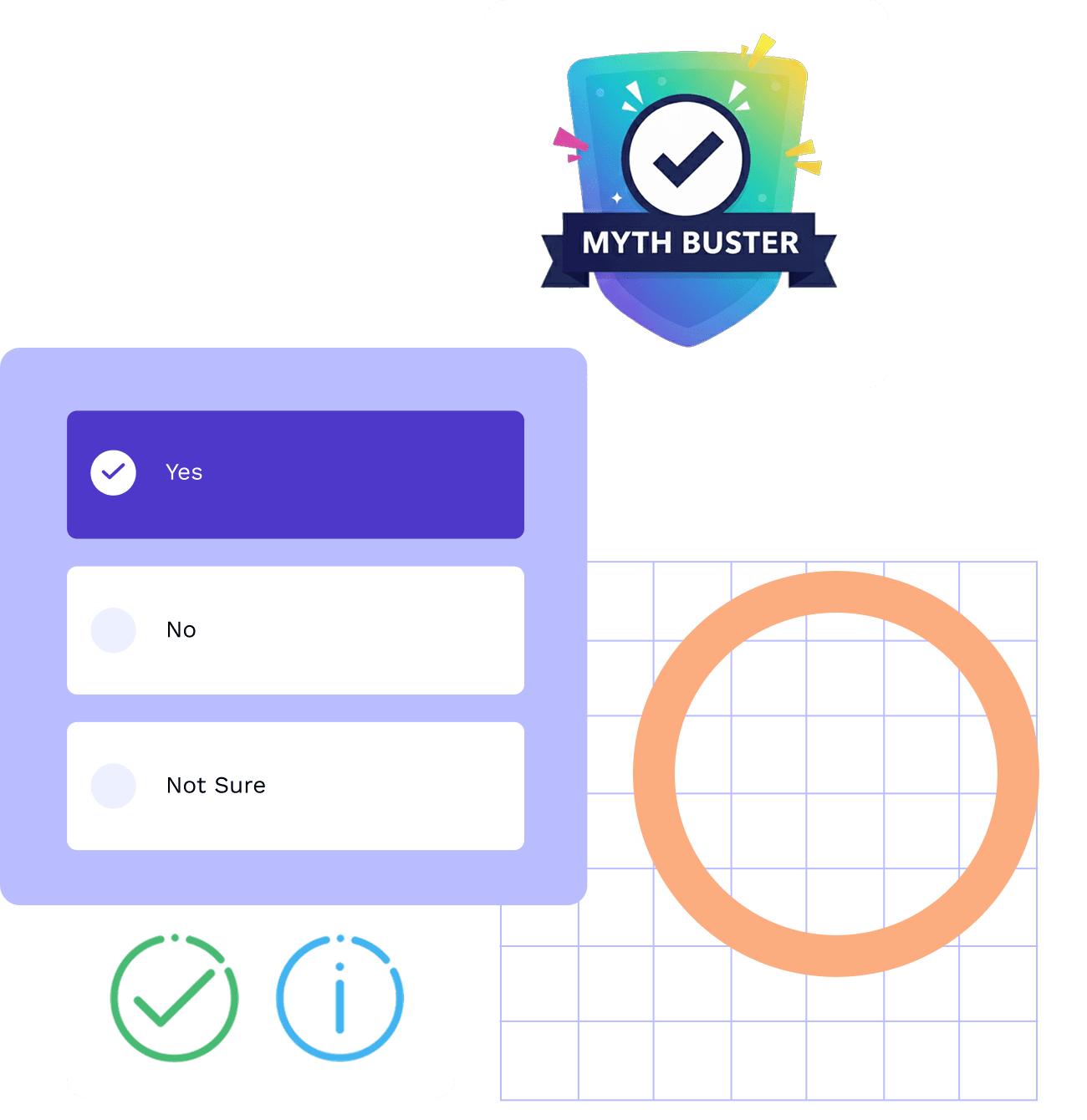
Rather than presenting information passively, the tool reframes career guidance as a decision-science problem. Users are presented with common career claims, asked to commit to an answer, and then shown corrective feedback grounded in credible labour market evidence. The goal was not persuasion, but reflection — creating moments where users could test and update their assumptions.
From evidence to usable tool
Vox Pop Labs designed and delivered Career Myth Buster as a research-informed digital product, combining behavioural science, survey methodology, and public engagement design.
The platform takes the form of an interactive quiz covering widely held beliefs about degree value, earnings, employment prospects, and job satisfaction. For each claim, users judge whether it is fact or fiction before seeing an evidence-based explanation.
Behind the interface, Vox Pop Labs worked closely with partners to ensure each item was grounded in credible data while remaining intelligible to a non-specialist audience. Throughout, the emphasis was on clarity without oversimplification: communicating uncertainty where appropriate, avoiding prescriptive advice, and foregrounding evidence over opinion.
Making evidence meaningful
By asking users to commit to an answer before revealing evidence, the tool draws on well-established findings from cognitive science about belief updating. This approach increases engagement and makes users more receptive to corrective information.
At the same time, anonymized response data allows researchers and practitioners to observe which myths are most persistent, where misunderstandings are most pronounced, and how beliefs vary across users. In this way, the tool operates as a feedback system, offering insight into how career misinformation circulates and where future interventions may be most effective.
Methodological rigour behind a simple interface
Although designed for broad accessibility, Career Myth Buster was underpinned by the same standards of rigour that characterize Vox Pop Labs’ academic and policy research.
Question wording and feedback explanations were tested to avoid bias or misleading simplification. Claims were linked to up-to-date [ Canadian ] data sources wherever possible, and limitations were acknowledged explicitly rather than hidden. This commitment to transparency ensures the tool can be used confidently by educators, guidance counselors, and institutions as a credible evidence-based resource.
What changed in practice
Career Myth Buster has been adopted by career educators and guidance professionals [ across Canada] and launched publicly by CERIC as part of its mandate to strengthen career development practice.
The project demonstrated that complex labour market evidence can be translated into formats that are engaging, accessible, and educational without sacrificing accuracy or nuance. More broadly, it showed how digital tools can confront misinformation constructively, by inviting users to test their beliefs rather than simply telling them they are wrong.
Vox Pop Labs capabilities demonstrated
Career Myth Buster highlights Vox Pop Labs’ ability to design and deliver evidence-informed public tools, including behaviourally informed question design, translation of complex data into accessible formats, public-facing digital engagement products, responsible communication of uncertainty, and research embedded directly within real-world tools.
These capabilities are especially relevant in contexts where misinformation, unequal access to guidance, and high-stakes individual decisions intersect.
Why decision tools matter
Career Myth Buster demonstrates how public tools can have greater impact when they are built to guide better decisions, using evidence and insights from behavioural science—rather than simply communicating information.
For Vox Pop Labs, the project exemplifies a core approach: building products that sit between research and practice — tools that respect users’ intelligence, surface evidence transparently, and help people make better decisions in environments shaped by uncertainty and myth.